

Explaining the Matrix – Disquiet
At this moment, the Disquiet Junto music community has begun the third week of its three-week “trios sequence.” These trios make up one of my favorite examples of Junto projects, and we’ve done it pretty much every year for many years now, and I’ve even considered doing it twice a year. I think people would enjoy that.
One irony of the “trios sequence” is that while it’s among the most popular projects for Junto participants, it also involves some of the longest sets of instructions. I work hard to keep instructions concise, even pithy, but I also, over time, have tried to compensate for previous misunderstandings or ambiguities. As a result, the instructions have grown.
Along the way, I also got in the habit of tracking Junto participants’ tracks in the trios sequence, using a shared read-only document. I do this with a primary aim: I want to, as moderator, do my best to make sure that, within reason, as many solos as possible have the opportunity to become duets, and as many duets as possible have the opportunity to become trios. I fear the complicated document, like the lengthy instructions, could be off-putting for people. I’m not sure explaining its inner workings helps much, but I figured I’d take this opportunity to break it down. It is, from the start of the first project in the sequence to the end of the third, very much a “living document,” in that it is constantly changing, not just adding data about new tracks but even shifting some explanatory text. Also, over the years, the document’s format has changed, benefiting from previous years of experience. Below is an attempt to break down and explain what’s what in the shared Google doc:
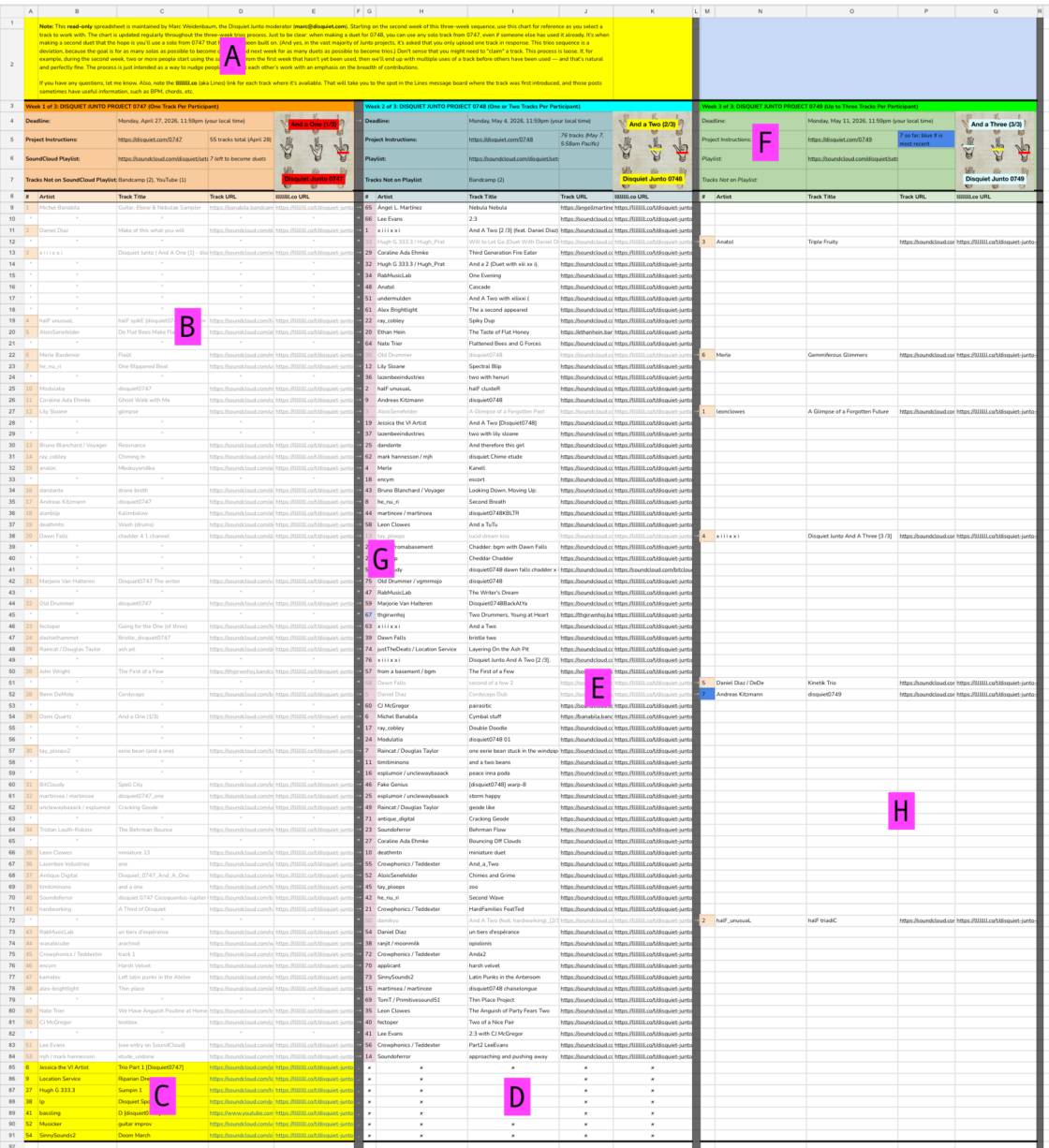
A — Introductory Text: This yellow cell is just a little introductory statement about the document and the projects. I adjust this text occasionally over the course of the sequence of the three trios projects. Almost everyone who visits this document does so from somewhere else, like from the Lines (llllllll.co) discussion threads or from the Disquiet Junto email newsletter or via social media, and so they already have a sense of what the document is before they get to it. This particular section, in yellow, is more for those few people who, for whatever reason, arrive at the document cold.
B — Main Column: This initial main column (of three total), or set of columns, contains the first week’s entries, which are the solos. There were 54 solo in all for this project. The reason they are spaced out vertically, with lots of what look like blank lines, is because come week two, when the duets were made, many of the solos became duets more than once. When a second duet is made of a given solo, a new row is introduced below it, so the two duets can be stacked in the second main column. If you look closely, those inserted rows are not blank. The columns have quotation marks in them, to signify “same as above.”
C — Un-duet’ed Solos: Of the original 54 solos created in the first project, there were 7 that, unfortunately, were not turned into duets. After the duets, in week two, started popping up, I began highlighting in yellow the solos that had not yet become duets. At first they were interspersed among the other solos. After a while, I collected them at the top of the list, to prioritize them further. Eventually, when the duets project was over, I moved them to the bottom of the list, since they naturally don’t play a role in the third week. A few of the solos became duets pretty late, at least one the morning that the trios project began. Late additions made for a nice gesture, giving as many people as possible the chance to hear their solo in context. At least one of the solos wasn’t easily downloadable, which may have contributed to it not having been selected.
D — Blank Area: This bottom portion of the second main column, for the duets week, is, per C above, the set of 7 solos that didn’t become duets.
E — Black / Gray / Blue: You’ll note that some of the text in this second main column is gray, while the majority of it is black. All the tracks begin in black text, and when the solos became duets and the duets became trios, I gray out the text, just to single they’ve been used. Anyone who participates in week two or three can turn any solo into a duet and any duet into a trio. The reason I highlight the distinction is twofold: A, just to nudge the unused tracks; B, because anyone who does an additional duet or an additional trio is asked to do so on a track that has not yet been utilized. Also, if you look to the right, you’ll see one little cell in blue. That individual column is, as in the other two main columns, where I count how many tracks have appeared. I mark the most recent one in blue, just to make it easy for me to recall when another one pops up.
F — Basic Info: This colorful row is just basic header information for each of the three main columns. It repeats key information, like the deadline and the playlist link. Over the course of the given column’s respective week, I keep count here of how many tracks have appeared.
G — Arrows & Dittos: If you zoom in here, you’ll see there is, in the gray vertical line between the first and second main columns (and as well between the second and third main columns), a pattern of arrows and quotation marks (or ditto marks). The first time a solo is turned into a duet, there is a little arrow showing the transition from one column to the next. Any time a second, third, etc. duet is added, those are marked with quotation marks. Same happens when duets eventually become trios.
H — Yet to Come: And since I made this screenshot early on the morning of the third project, there is a lot of white space in the third main column, which is the trios column. There were four or five tracks when I first woke up, in California, and two or three more arrived while I was getting things going, like posting the instructions on the llllllll.co message board, which is where most Disquiet Junto discussion occurs, and on social media, among other places. This column will continue to fill up as the days pass, and there will almost certainly be duets that give rise to more than one trio, in which case the document will add rows, as well.
And here’s an update: A musician opted to make a trio by first combining two of the solos, rather than working from a duet. This allowed two solos that had not become duets to still be built upon. That creative choice required me to think for a moment about how to represent the activity on the grid. I did the following:



